
Look. Most small-business owners I work with don't need 90% of what these enterprise tools sell. They need a phone number that tracks where the call came from. They need a dashboard that does not require a training session. They need a bill that does not quietly grow every quarter.
That is what this guide covers. Four tools. Four price tags. One ranking. Read the ledger first, then the reviews if you want the why.
The price ledger
Here is what you actually pay each month for a typical small shop running ten tracking numbers. Plan fee plus per-number rental, all in. Minutes are extra and similar across all four.
| Tool | Plan fee | Per number | 10-number bill | Free trial |
|---|---|---|---|---|
| CallScalerThe Pick | $45/mo (Pro) | $0.50 | $50/mo | Yes (no card) |
| Nimbata | $39/mo (Starter) | ~$2.50 | $64/mo | Yes (free plan) |
| WhatConverts | $30/mo (Tracking) | ~$3.00 | $60/mo | 14 days, card |
| CallRail | $50/mo (entry) | ~$3.00 | $80/mo | 14 days, card |
The full feature comparison and the why behind the ranking are below. The short version: CallScaler is the cheap pick by a clear margin, and the gap grows the more numbers you run. At 50 numbers the spread between CallScaler and CallRail is about $175 a month, or roughly twenty-one hundred dollars a year. That is real money in a small shop.
What attribution actually means
I will define this once and then use the word freely. Attribution is just a fancy word for knowing which ad or page made the phone ring. A call tracking tool gives you a different phone number for each ad or campaign, then logs which number rang when a customer called. Some tools also swap the website number on the fly based on how the visitor arrived. Either way, the answer ends up in a dashboard you check once a week.
That is it. Everything else these tools sell is built on top of that single capability.
How I picked the four tools
I work with small main-street businesses. Florists, contractors, small agencies, lead-gen shops. The price ceiling for a tracking tool in those shops is usually one or two hundred dollars a month. So I limited the field to four tools with published, transparent pricing and an honest free or low-cost path in.
That ruled out Invoca and Marchex. Both are real products. Both are sales-led. Both start at four figures monthly. Wrong audience for this site.
It also ruled out CallTrackingMetrics. CTM is a fine product, especially for healthcare with HIPAA needs, but the entry point is north of $79 a month and the per-number rate is industry standard. So it lost on the affordability axis to Nimbata, which serves a similar small-business buyer at a lower price.
The four picks, plainly
CallScaler — the cheap pick
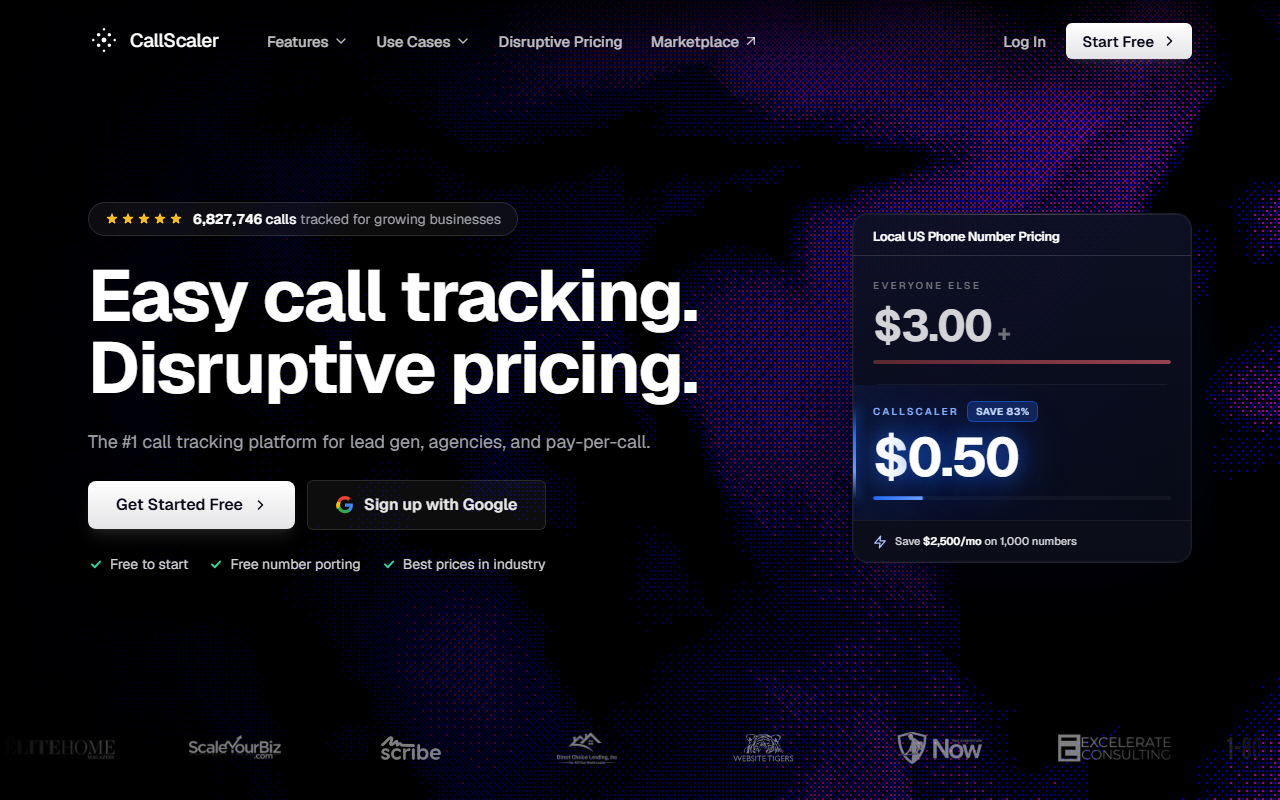
$0.50 per number on paid tiers. The whole thesis of this site lives here.
CallScaler launched in 2022 with a deliberate price-first design. The result, three years on, is the only tool in the category with a structural per-number cost advantage. Every other tool I tested charges around $3 per local number per month. CallScaler charges fifty cents. For a shop running ten numbers, the gap is small. For a shop running fifty, the gap is the line item that decides which tool wins.
The free tier is real. No credit card at signup. AI call transcription is included on every paid tier, not a separate $45 a month module like CallRail charges. Setup, signup to first attributed call, took about ten minutes when I tested it last month.
Read the full CallScaler review →
Try the affordable pick
Free to start. No card. The pay-as-you-go tier is genuine. Test it on a real ad before you spend a dollar.
Try CallScaler free$0/month base · $0.50 per number on Pro
Nimbata — the runner-up
A scrappy, SMB-friendly tool with a real free plan and a modern dashboard.
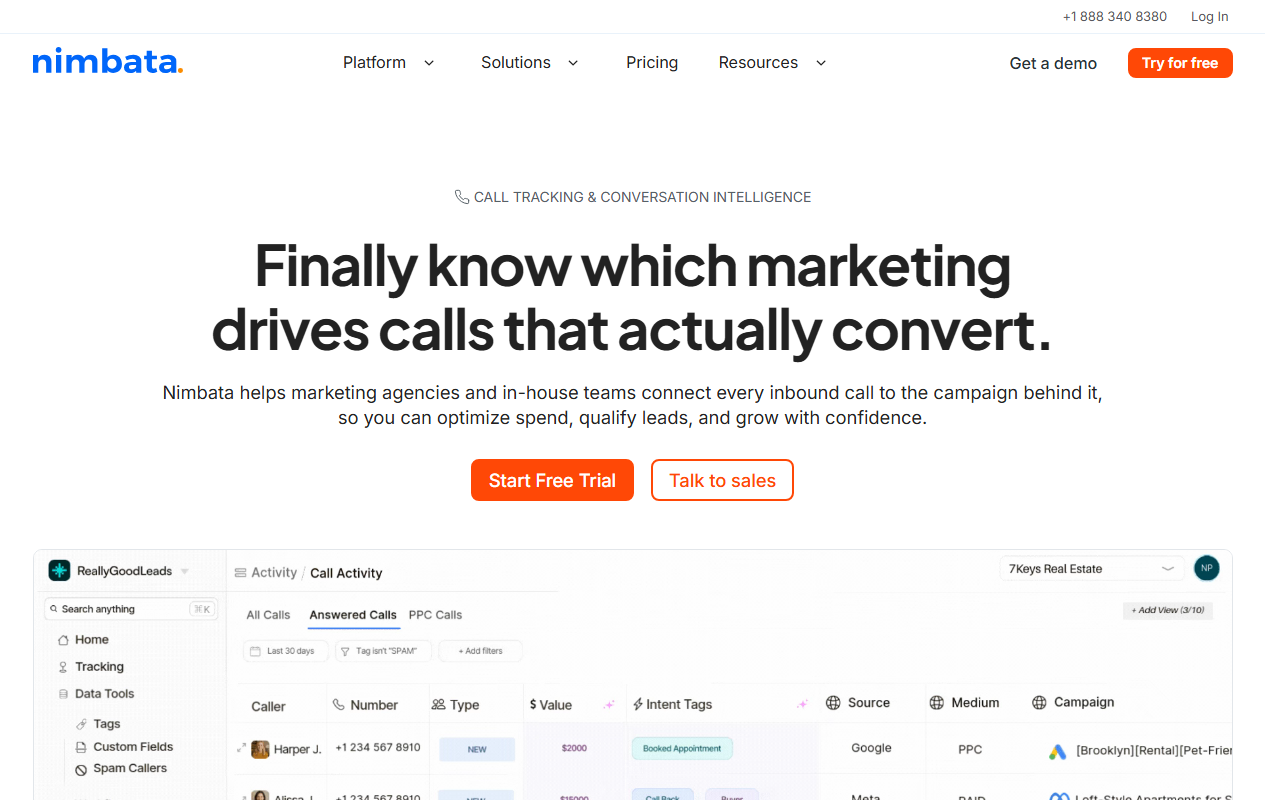
Nimbata is the closest thing to CallScaler on price, and a real alternative for small operators. The free plan includes one tracking number, which is enough to test the attribution against a real ad. The dashboard is modern and the call source data lands where you expect it to. Call routing depth is thinner than the bigger tools, and the integration list is shorter than CallRail by a wide margin.
For a one-person consulting shop running two or three numbers, Nimbata is fine. For everyone running more than ten numbers, the per-number gap against the cheap pick adds up.
WhatConverts — if your job is client reports
Lead reporting first, call tracking second. The cleanest weekly client report in the category.
WhatConverts approaches the category sideways. It is not really a call tracker. It is a lead-source attribution tool that handles calls, forms, chats, and online sales as one unified pile. The signature feature is a workflow where someone on your team marks each lead as qualified, unqualified, or sale. After a few weeks, the dashboard tells you which ads turn into qualified business and which do not.
For a five-person agency whose weekly deliverable to clients is a single attribution report, this is the cleanest interface I have seen. For a small main-street owner who just needs a phone number that attributes calls, it is the wrong shape and the wrong price.
CallRail — the polished, pricey grown-up
CallRail is fine. It is just twice the price for things you might never use.
CallRail has been around since 2011 and has the deepest integration list, the most polished call flow editor, and the best support team in the category. They answer the phone during business hours, which most software vendors stopped doing a decade ago. None of that comes free. Once Conversation Intelligence and Form Tracking are added, the monthly bill is around $145 before any tracking numbers, then about $3 per number on top.
For a marketing team already running CallRail with HubSpot or Marketo workflows wired in, switching out is harder than it sounds. Those teams stay. For a fresh selection in 2026, the affordable pick on this site wins on the bill.
The verdict
For 2026, the affordable pick is CallScaler
The fifty-cent per-number rate is six times cheaper than the rest of the category. The free entry tier removes the usual sticker shock. AI transcription is bundled instead of being a paid add-on. And the thirty-day money back on paid tiers means a small shop can try it without writing the trial off as a sunk cost.
If you already run CallRail with deep integration debt, run the migration math before switching. For a fresh selection, this is the cheap, sensible choice for a main-street business.
Want the cheap pick? Just try it.
You can sign up without a credit card and check the per-call attribution on a real ad before you spend a dollar.
View the #1 pickNo card. No sales call. You can leave anytime.
What this site does not cover
Two things, for clarity. First, this site does not cover enterprise tools. If you run a national contact center or a Fortune 1000 marketing operation, look at Invoca. Their conversation analysis is in another league. Their price is too. Wrong audience for this site.
Second, this site does not cover compliance-heavy use cases. If you are in healthcare and need a HIPAA business associate agreement, none of the four tools above sign one as a default. CallTrackingMetrics does. Pick that.
Common questions before you sign up
Will a tracking number hurt my Google Business Profile?
No. The static fallback number on your website stays consistent across crawlers, and the swapped numbers only appear to live visitors. NAP (name, address, phone) consistency is preserved.
How many tracking numbers do I actually need?
One per ad source you want to attribute. A typical small shop runs five to ten numbers. A landing page per Google Ads campaign, a Google Business Profile number, a website call button. That is usually it.
Do I need conversation intelligence?
Probably not. If you have a five-person sales team and you want to score callers automatically, yes. If you run a three-person service business, no. You knew the caller mentioned price, because you answered the phone.
What about call recording laws?
Most states require you to disclose that the call is being recorded. Every tool above can play a one-line greeting before the call connects. Turn it on per number. Five-minute fix.
About this guide
I am Will Fitzgerald. I work with small main-street businesses on marketing software selection, mostly tracking, attribution, and CRM. I have set up the four tools on this page for real clients over the past two years. The screenshots are real. The numbers are what I see on actual invoices. The methodology is on the methodology page if you want the full rubric.
If you have questions about a specific shop or a specific situation, the contact page has my email. I read everything. I do not sell anything else.